
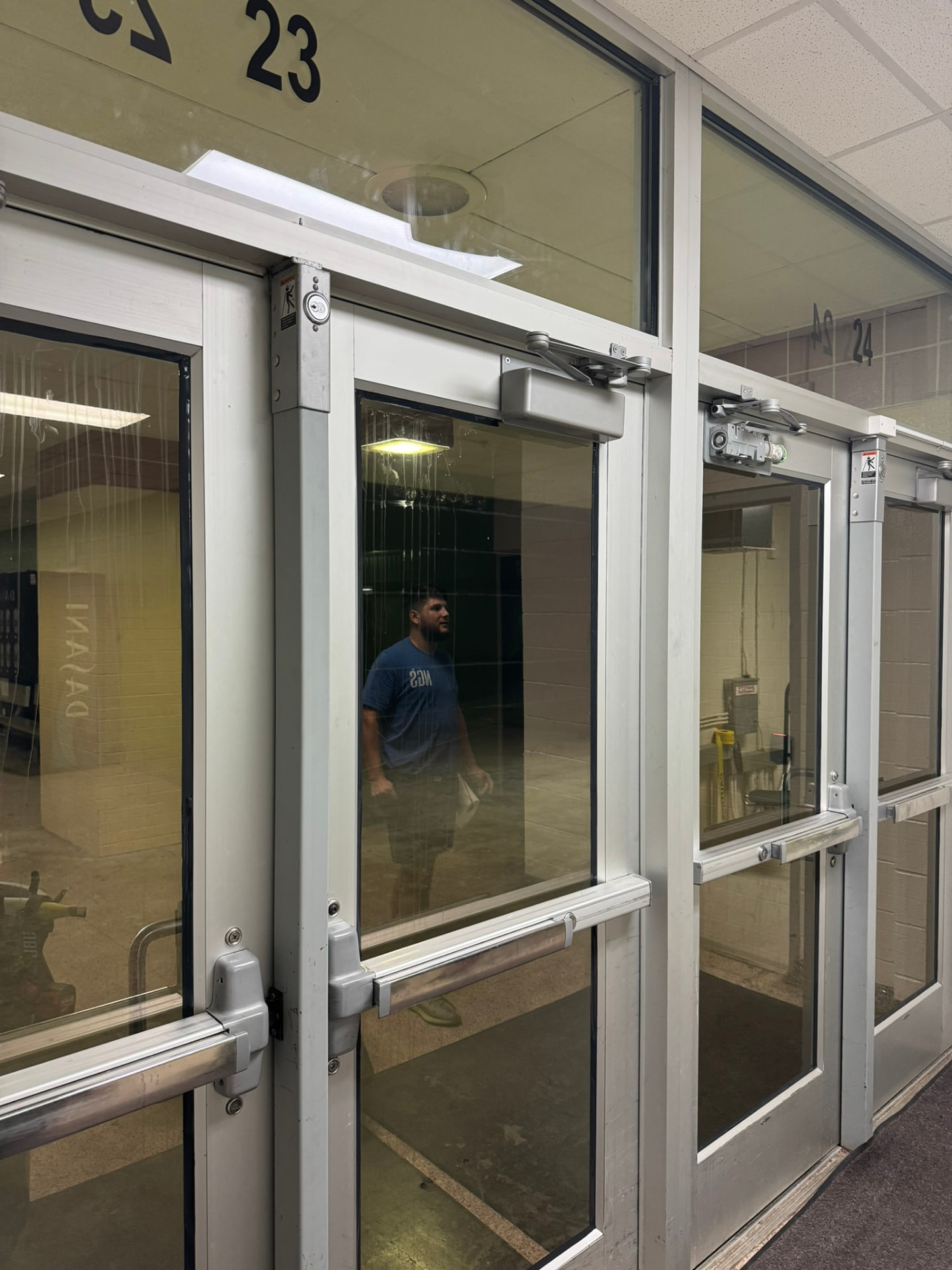
1. Evaluate entry glass and the surrounding opening
Bring your facilities director and school safety team into the initial walk-through. Identify entry vestibules, front office glass, door sidelites and accessible ground-floor windows. Classroom vision panels, cafeteria glass and corridor glazing may also belong in the scope, depending on the district's assessment. A photograph alone is not enough to specify a protective system.
- Give each opening a campus, building and opening ID. Record approximate width, height and pane count.
- Document glass type and thickness if known, existing tint or coatings, and the frame and sealant condition. Flag unknowns for the site visit rather than guessing.
- Identify damaged glass, loose frames or deteriorated seals for review before installation.
- Separate the desired outcomes: broken-glass retention, forced-entry delay, solar control or privacy. They are not interchangeable performance claims.
Coordinate the proposed work with district requirements for visibility, exits, accessibility and other applicable building obligations. Film is not a substitute for secure doors, access control, emergency procedures or a qualified safety assessment.
2. Compare complete film-and-attachment systems
Safety and security film can help hold broken glass together. The way the filmed glass connects to the frame matters: an attachment system may be required to help retain the fractured pane within the opening. Ask for the manufacturer's requirements for the specific product and application; do not assume every frame accepts the same attachment detail.
Request a written specification identifying the film, glass construction, compatible attachment and preparation method. If a proposal cites a test, ask for the report and compare the tested glass, frame, attachment and film with your proposed opening. Film thickness alone does not establish forced-entry performance, a delay time or compliance with a district requirement.
Keep ballistic resistance separate. Ordinary safety and security film does not stop bullets. A separately specified C-Bond BRS system is a different offering; any ballistic claim must be tied to the tested system and its installation requirements, not to all window film.
3. Build an opening-by-opening project scope
For a single campus, identify the first set of openings to assess. For a district, group the work by campus and building so proposals can distinguish priorities, quantities and phases. Avoid comparing quotes by square footage alone when preparation, attachment or access differs.
Project request checklist
- District or organization name, contact person and facilities or safety role.
- Campus and building counts, approximate opening counts and the areas to assess.
- Desired protection, known glass details and any existing specification or test requirement.
- Preferred timeline, funding source and proposal documentation requirements.
- Access arrangements and any district requirements for personnel, occupied areas or purchasing.
The Alpha Shield school project request accepts campus counts, opening counts, scope, timing and funding information. Select “Not determined yet” when funding is undecided. A funding selection does not establish grant eligibility or approval. Keep sensitive campus vulnerabilities and security plans out of the public form; arrange their review directly with your district's authorized contact.
4. Coordinate installation and return to service
Discuss summer breaks, other school holidays or after-hours access before committing to a phase. Confirm availability rather than assuming a particular date. Agree on room access, furniture clearance, cleaning, work-area separation and how the crew will move between buildings without disrupting occupied areas.
Ask the installer for product-specific drying, attachment curing and cleaning instructions. Installation completion is not necessarily the same as readiness for the intended protective performance. Conditions and products differ, so obtain a written handover schedule rather than applying one universal cure time.
At handover, retain opening IDs, installed product and attachment details, warranty information, care instructions and any applicable test documentation. Agree on how concerns about edges, seals or damaged glass should be reported and reviewed.
Questions to ask before approving a proposal
- Which openings are included, and which need repairs or further glass identification?
- What is the intended protection, and what evidence supports this exact proposed system?
- Is attachment included where required, with compatible frame and sealant details?
- What preparation, access, phased scheduling and curing restrictions affect the school?
- What documentation, warranty and ongoing inspection guidance will the district receive?
Build a comparable district proposal package
Give each bidder the same opening schedule and requested phases. Ask for separate line items for glass preparation, film, attachment, access arrangements and any excluded repair work. Require a list of assumptions and exclusions so a lower total is not mistaken for an equivalent scope.
Request product names, current manufacturer installation instructions and any test reports supporting the proposed protection. A school project photograph or district name is context, not proof that your proposed glass-and-frame assembly meets a test. Ask for permission-cleared references for comparable work and confirm which company performed it; do not infer Alpha Shield's installation history from LeWolf's photo collection.
Have your district's facilities and purchasing teams review the opening schedule, evidence, access requirements and completion documents together. Resolve unknown glass details and required attachment before approving the final scope; record any changes campus by campus.
Plan your school's next step
Alpha Shield is a 3M Authorized Window Film Dealer based in Magnolia, serving school projects alongside home and commercial applications. Share your campus count and initial scope to begin a discussion about assessment and a written proposal.
School security film questions
Questions about protection limits, attachment, cost or installation timing?
Security window film for schools: FAQManufacturer references
Texas school security film requirements & funding
Use the current instructions for the specified product. These references explain school applications, installation limitations and attachment requirements; they do not certify a particular campus or proposed opening.
- 3M: Window film for schools
- 3M: Safety and security window film installation guidelines
- 3M: Impact Protection Attachment technical data sheet
Last updated October 17, 2026